Diamond Education & Glossary
loose diamonds on white table with red fabric lining
remarkable origin stories
Diamond Sources

Can you tell the difference between a lab-grown and an earth-mined diamond? The simple answer is no. Both appear to be visually identical. A lab-grown diamond has the same qualities and chemical makeup as a natural diamond.

[Blog] Lab or Natural?
bright white diamonds on contrasting black carbon rocks with one round diamond being lifted with tweezers
Color, Clarity, Cut, Carat
The 4C's

Diamonds can be used to increase the value and significance of various pieces of jewelry, including engagement rings, wedding bands, bridal sets, necklaces, bracelets, and others. Grade and quality are used to evaluate diamonds. The primary factors used to determine whether a stone is the best match are the "4 C's": cutcolorclarity, and carat.

Before choosing a specific piece, the 4 C's of diamonds may help you decide what to look for in a center stone and side stones.

[Blog] Learn Your C's

What's Your Angle?

The Crown & Pavilion

Crown Height

The portion of the diamond that extends from the girdle to the top of the table is called the crown...

Crown Angle

The crown facets behaving as prisms play a crucial role in light dispersion...

Pavilion Depth

The amount of light returned by the stone is affected by the pavilion's depth...

Trusted Diamond Grading Organizations
Certifications

From GIA to IGI. A diamond certificate acts as a formal report on a stone's specifications. A diamond's internal markings, inclusions, and other properties are used to identify it.

[Blog] How to Read a Cert
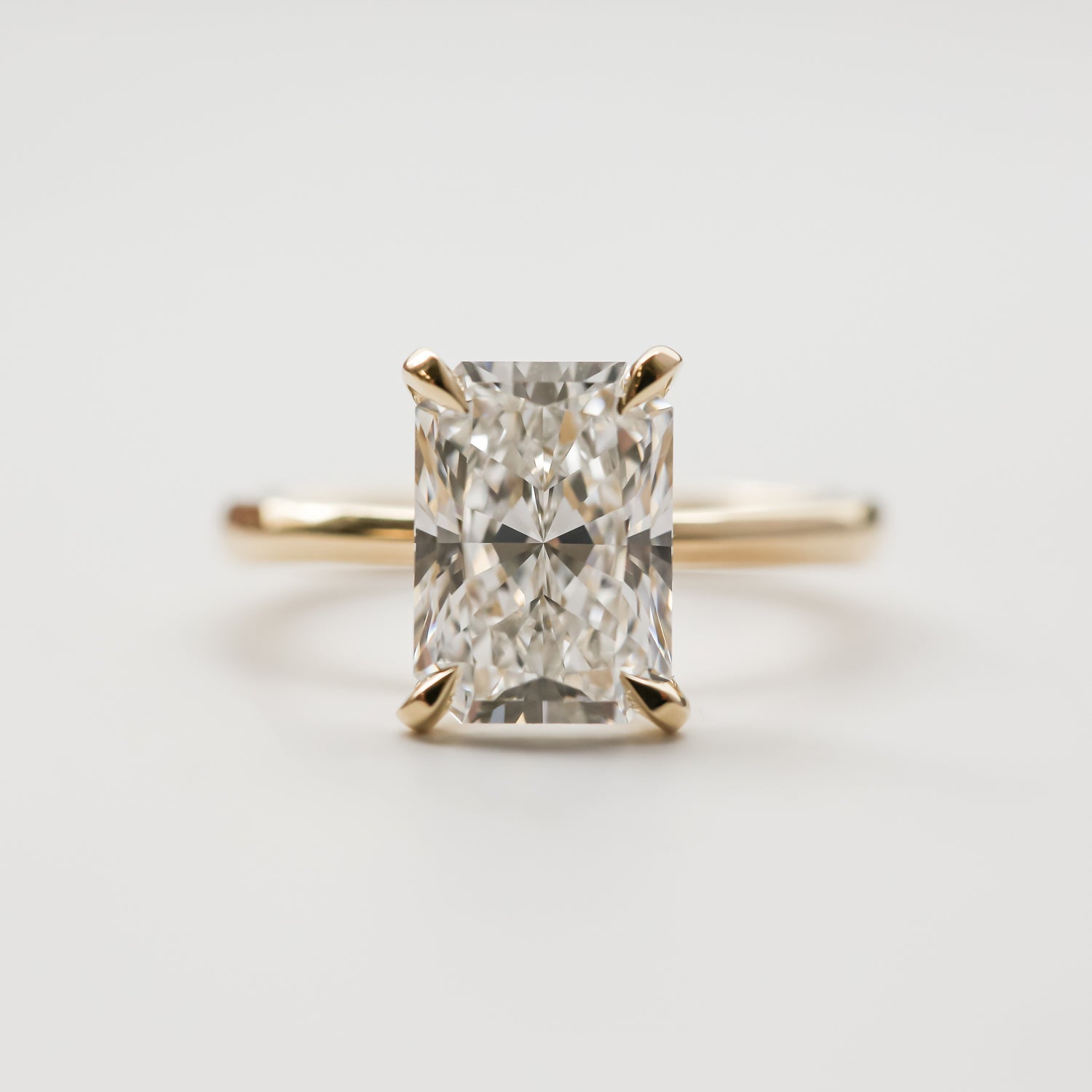
Kobelli Custom Tailored Basic Diamond Ring - featuring a radiant-cut diamond of excellent symmetry
Beyond the C's
Polish & Symmetry

The significance of a diamond's polish and symmetry in evaluating the overall quality of a diamond is roughly 50%. These two criteria are included in diamond certificates, also known as are grading reports. To obtain an ideal stone, the stone must have the proper polish and proportions...

[Blog] Learn how it's graded
round brilliant colorless stones on wooden surface
to glow or not to glow
Fluorescence

Diamond fluorescence is a trait that can make lower-color diamonds (I-M) appear whiter and more vibrant, often for a lower price. While it can enhance warm-toned stones, very strong fluorescence may cause a milky or hazy appearance in high-color (D-F) diamonds, slightly reducing their value.

When a diamond is exposed to long wave Ultra-Violet (UV) light, the amount of a colored glow (often blue) that is visible is referred to as diamond fluorescence...

[Blog] Read on

Diamond Shapes


Round Shape Cushoin Shape Radiant 

Shape Pear Shape Asscher 

Shape
Oval Shape Princess Shape Emerald Shape Marquise Shape Heart Shape  


Click the image icons above to go more in depth into each shape.