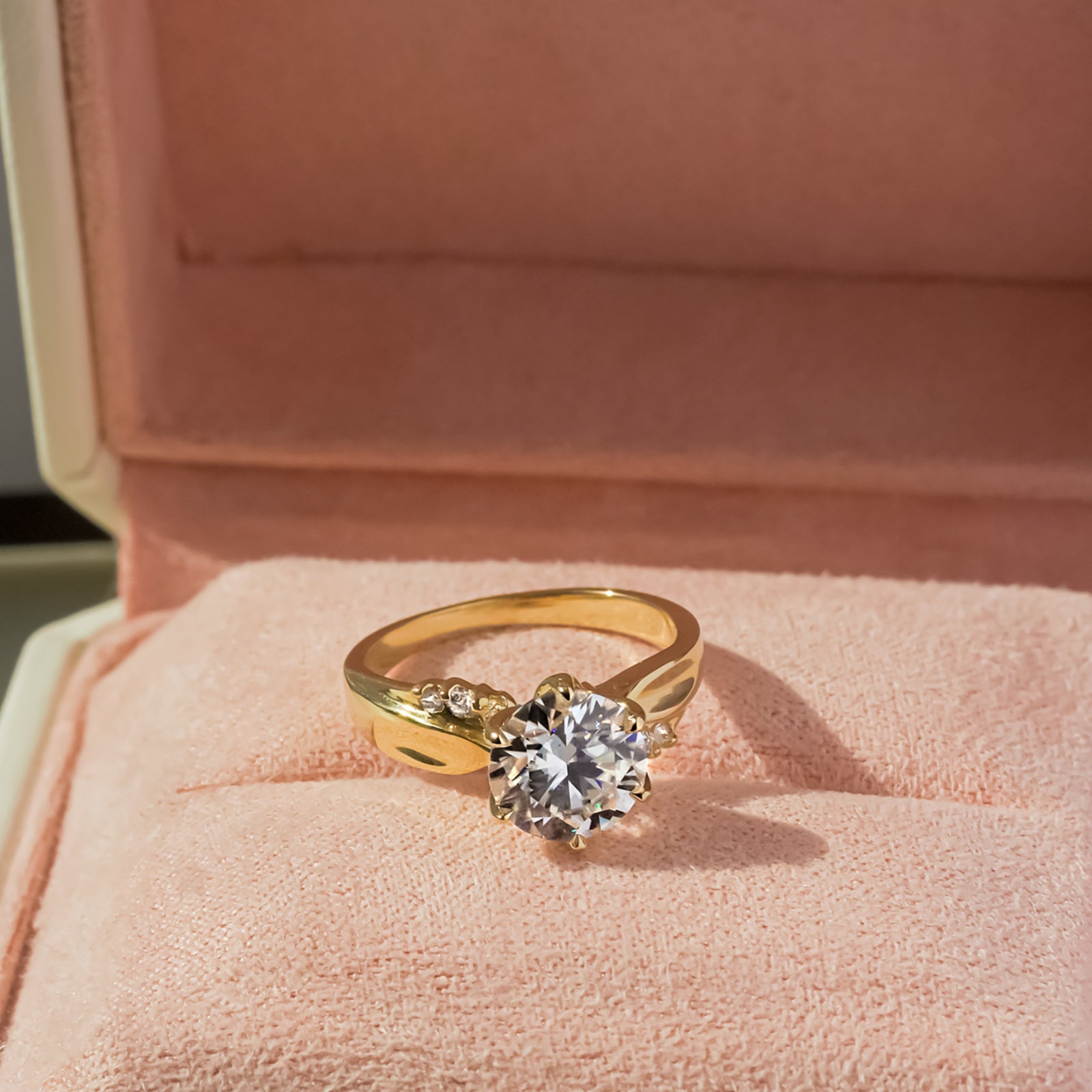

Moissanite vs. Lab-Grown Diamond: The Honest Guide (2026)
We get asked this every single day.
“Should I go with a lab-grown diamond or moissanite?” And honestly? It’s one of our favorite questions to answer — because there’s no wrong answer, and we sell both. That means we have absolutely no reason to steer you toward one over the other. What we care about is that you walk away with the ring that’s right for your relationship, your budget, and the way you want it to look on your hand for the next fifty years.
So let’s get into it — clearly, honestly, and without the upselling.
The Quick Comparison
|
|
Lab-Grown Diamond |
Moissanite |
|
Material |
Pure carbon |
Silicon carbide |
|
Mohs Hardness |
10 (hardest known mineral) |
9.25 |
|
Sparkle Type |
White/colorless brilliance |
Rainbow “fire” — vivid, colorful flashes |
|
Price Range |
30–60% less than mined diamonds |
More affordable than lab-grown |
|
Certification |
GIA or IGI graded |
Not diamond-graded |
|
Color Grading |
D–Z scale |
Near-colorless (may show warmth in certain light) |
|
Daily Wear |
Excellent |
Excellent |
|
Resale Value |
Emerging market; better than moissanite |
Low |
|
Origin |
Lab-created, conflict-free |
Lab-created, conflict-free |
Both stones are durable enough for a lifetime of daily wear. Both are created in a lab, which means neither contributes to the human and environmental costs associated with mined diamonds. Both are beautiful. The differences come down to look, feel, and what matters most to you.
Why Lab-Grown Diamonds Are Worth It
A lab-grown diamond is, in every scientific sense, a real diamond. It has the same chemical composition as a mined diamond — pure carbon — the same crystal structure, the same optical properties, the same hardness of 10 on the Mohs scale. The only difference is that it was grown in a controlled environment over weeks rather than formed underground over billions of years.
Because we’re a direct manufacturer and source our diamonds straight from cutters around the world, we’re able to offer lab-grown diamonds at 30–60% less than their mined equivalents. You’re not paying for a century of retail infrastructure. You’re paying for the stone itself and the craftsmanship of the ring.
Every lab-grown diamond we sell comes with either a GIA or IGI certificate. That’s a third-party, internationally recognized grading report that tells you exactly what you’re getting — cut, color, clarity, and carat weight. The grading system is the same D-to-Z color scale used for mined diamonds, which means you can shop with precision and compare stones objectively.
What lab-grown diamonds offer:
· Identical sparkle to mined diamonds — the classic white brilliance most people picture when they think of a diamond engagement ring
· Third-party certification (GIA or IGI) for every stone
· Traditional look and feel that partners, family, and friends recognize
· Better resale potential than moissanite, though the lab-grown resale market is still maturing
· Ethical, conflict-free sourcing with full transparency
If your partner loves the classic diamond look, values certification and documentation, or simply wants to say “yes, it’s a diamond” — lab-grown is the move.
Why Moissanite Is Worth It
Moissanite is not a diamond. It’s silicon carbide — a completely different mineral with its own remarkable properties. It was first discovered in 1893 inside a meteor crater in Arizona, and today it’s grown entirely in laboratories. It scores 9.25 on the Mohs hardness scale, which makes it the second hardest gemstone used in jewelry. For all practical purposes, it’s just as durable as a diamond for everyday wear.
Here’s the thing that surprises most people: moissanite actually sparkles more than a diamond. More precisely, it refracts light differently — producing what jewelers call “fire,” which shows up as vivid rainbow flashes. Under direct light or in motion, the effect is dramatic and beautiful. Some people fall absolutely in love with it. Others prefer the more traditional, white brilliance of a diamond.
The other big advantage is price. Moissanite costs significantly less than lab-grown diamonds, and because it’s priced by size rather than carat weight and grading tier, you can often go considerably larger for the same budget.
What moissanite offers:
· Vivid rainbow fire — a more colorful, intense sparkle that stands out in any light
· More stone for your budget — larger center stone for significantly less money
· Hardness of 9.25 — exceptionally durable for daily wear
· Conflict-free, lab-created — same ethical story as lab-grown diamonds
· A unique look that many wearers prefer over traditional diamonds
If your partner lights up at something with serious sparkle and wants the most visual impact for the budget, moissanite delivers that in a way nothing else quite matches.
Which One Is Right for You?
This isn’t a “one is better” situation. It’s a “which fits your life” situation. Here’s the honest breakdown:
Choose a lab-grown diamond if:
· Your partner wants a traditional diamond engagement ring — the look, the feel, the ability to say “it’s a diamond”
· Certification and documented grading matter to you
· You want the closest match to a mined diamond at a fraction of the price
· Resale or long-term value is part of your decision-making
Choose moissanite if:
· You want the most spectacular sparkle available — the rainbow fire effect is genuinely stunning
· Budget is a priority and you want a larger, showier stone
· Your partner has seen moissanite and loves how it looks
· You care deeply about ethics and value that both options are lab-created, but want the more affordable choice
Still not sure? That’s exactly why we offer personal consultations. We can walk you through both options side by side, talk through your partner’s style, and help you land on the right call — with zero pressure and zero commission. Book a time with us below.
Frequently Asked Questions
Is moissanite “fake”?
No. Moissanite is a real gemstone — silicon carbide — with its own chemical composition, hardness, and optical properties. It’s not an imitation of anything. It’s its own mineral, grown in a laboratory with exceptional quality. Calling it fake is a bit like calling a lab-grown ruby fake because it wasn’t mined. The stone is real; it’s just not a diamond.
Will my partner be able to tell the difference between a lab-grown diamond and moissanite?
Probably not from visual inspection alone. The stones look very similar in everyday settings. The most noticeable difference is the sparkle: moissanite produces more colorful rainbow flashes under direct light. If your partner is familiar with both, they may notice the fire difference. If they aren’t specifically looking for it, most people can’t tell. A jeweler can distinguish them with a tester, but that’s not something that comes up in ordinary life.
Which holds its value better?
Neither holds value as well as a quality mined diamond, and you should go into any gemstone purchase understanding that jewelry is an emotional purchase, not an investment. That said, lab-grown diamonds have a more established resale framework than moissanite, and as the lab-grown market matures, that gap may close. Moissanite has very little resale value. Neither is purchased primarily for resale — they’re purchased because they’re beautiful and meaningful.
Can I upgrade my stone later?
Yes, in most cases. Because we manufacture in-house and offer customization on nearly every piece, we’re able to work with you on upgrades or remounts. The specifics depend on the setting and the original stone, so the best approach is to reach out to us directly at CUSTOM@KOBELLI.COM to talk through your options.
Which sparkles more?
Moissanite. By a noticeable margin, and it’s not close. Moissanite has a higher refractive index than diamond, which means it bends light more dramatically and produces more vivid rainbow flashes. If maximum sparkle and fire is the priority, moissanite wins. If you prefer the classic, clean white brilliance that diamonds are known for, a lab-grown diamond is the right choice.
Ready to Find Your Ring?
We’ve been making engagement rings in our Los Angeles studio since 1980. We know these stones, we work with them every day, and we genuinely love helping couples find the right one.
Browse our full collection of certified lab-grown and moissanite engagement rings, or book a personal consultation and we’ll walk through everything with you.
Shop Kobelli Grown engagement rings
Or schedule a consultation with our team: Book a time